


When it comes to predicting cashflows, the forward curve is the standard assumption, but if there’s one thing we know for certain, it’s always wrong. Long time readers are familiar with the “hairy curve” included in our fix vs floating study here.
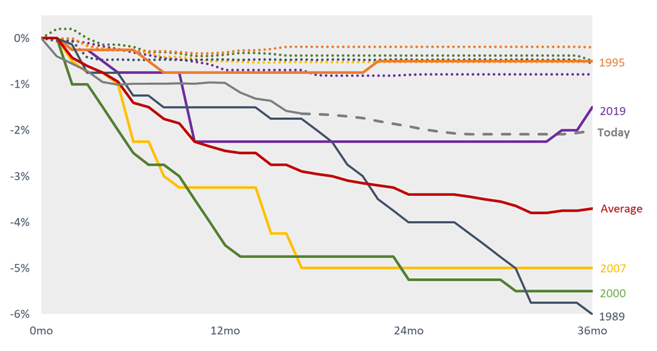
The graph below zooms in on the last five cutting cycles by comparing market rate projections to actual Fed Funds around the time of the first cut.
- Dotted lines – the amount of easing priced in just before the first cut
- Solid lines – the actual amount of easing
- Grey line – the solid portion represents cuts to date, and the dashed portion represents the current forward curve
Takeaways:
- Over the past five cycles, markets were pricing in roughly one to three 0.25% cuts around the time the first occurred.
- Except for 1995, the market has underestimated the magnitude of rate cuts.
Since August 2024, the Fed has lowered rates by 1.75% and the market currently expects just under two more 0.25% cuts. To date, the cutting cycle largely resembles 1989. Will the second half play out the same or will it be 2019 all over again?!
As we sit at a potential inflection point, it’s worth reviewing some of the potential strategies we’re seeing that could be leveraged to cover the years ahead.
Follow the lender’s minimum requirement
You know this one already. It typically consists of purchasing a series of shorter-term (e.g. 1-2 year) rolling interest rate caps at the max strike. The caps are extended for another year prior to maturity, but not much else goes into it.
Benefit
If rate expectations are overdone, this works pretty well. By purchasing the shortest term and highest strike, the potential value that would be eroded by rates falling is minimized.
Downside
If rate expectations aren’t overdone or are even higher in the future, then a series of caps could be exponentially more expensive than a longer-term cap is today. Everyone is familiar with this risk by now.
Quantifying the future cost in a similar or higher rate environment is possible too. We run these sorts of scenarios for clients all the time.
Middle ground
A proactive approach is to monitor the cost of the future cap extension on a monthly or quarterly basis. This is an easy way to keep tabs on the market and helps avoid being caught off guard in 11 months. If the market outlook begins to shift, we can always jump on a call to discuss if extending early makes sense.
Want help monitoring the cost to extend the various hedges in your portfolio? Just let us know. We’ve got you covered, even if we didn’t place the initial trade.
Aligned with the business plan
This might be a medium-term hedge (3-5 years) where the maturity is aligned with a target disposition date. Alternatively, the investment might be a longer-term hold with a 7-10-year fixed rate, which while less exciting at 5.50%-6.00%, still pencils. If your focus is transferring interest rate risk to someone else, there’s something to be said about peace of mind.
Benefit
If rate expectations are overdone, this still works well. You mitigated your rate risk, which was the goal to begin with!
Downside
Cap costs, while meaningful, are still manageable out to 3-5 years. Beyond that, they become prohibitively expensive, so a 5+ year hedge often ends up being a swap (when able). If rate expectations are overdone, you locked in a swap, but need to prepay early, the potential breakage could be significant.
Middle ground
A lower strike cap could be purchased for the earlier years of a loan and a higher strike cap or corridor for the later years. This limits the exposure over a longer period at a lower upfront cost.
Hybrid strategy
Now we’re talking. This is likely a combination of the above but using different hedge types, laddered maturities, step up/down strikes, etc.
Hybrid strategies seek to balance risk and cost today, while keeping an eye on the future. The goal is NOT speculating to make money on derivatives or to overcomplicate hedging strategies to justify a fee. Below, we’ll look at a recent example using generic numbers and current pricing.
Overview - $100mm loan, bank lender, 3+1+1, 3 year hedge at a 4.00% max strike.
Here are three common vanilla options that cover all 3 years with minimal cost

The borrower in the scenario was interested in swapping but indicated a sale after EOY 2 was possible and was concerned about the potential breakage. Below is a table outlining what that might look like over time and under different rate environments.
- By way of example, if 1 year remains and rates are 1.00% below current market expectations (implying a 2.43% 1 year replacement rate), the swap breakage would be $1.056mm.

One option that eliminates the potential breakage is to execute a 2 year swap and purchase a max strike cap for year 3. Here’s where that shakes out.
The borrower preferred not to come out of pocket for the cap, though. Therefore, we looked at a forward starting costless collar to cover year 3. The floor on that structure would shake out around 3.16% today.
Here’s a 2 year swap with a costless collar for year 3
This is a strategy we’ve seen numerous times recently. Like swaps, costless collars also have the potential for a breakage if they’re unwound early and rates are lower. However, the penalty is often much less than that of the equivalent swap.
The table below outlines the year 3 collar breakage under the same rate shocks.

And here is the percent decrease in the breakage by having a collar year 3 (in lieu of a swap). In the -1.00% scenario, the penalty is 35% lower than the swap!
Takeaways from the swap/collar:
- The strategy satisfies the hedge requirement all 3 years, reduces the potential breakage in year 3, and doesn’t have an upfront cost.
- If the borrower doesn’t end up selling in year 3, they still have the max protection in place but retain the ability to float down to 3.16% (or ~0.27% below current expectations).
Another simple strategy would be to execute a 50% swap and 50% cap
Since the swap rate is below the 4.00% strike requirement, the cap strike could be increased to 4.52% and still provide a max blended rate of 4.00%. Here are the new hedge costs.
Below is the same year 3 breakage table for the 50% swap. The 1.00% lower scenario has a penalty that’s even lower!
Takeaways from the 50% swap/50%cap:
- The strategy satisfies the hedge requirement all 3 years, reduces the potential breakage in year 3, has a more manageable upfront cost, and retains floating exposure on 50% of the debt!!
- Since 50% of the debt is still floating, this strategy can be especially useful when a partial release is likely, since there’s never a penalty on the portion floating with a cap.
Conclusion
There are numerous ways to approach hedging in the current environment, but hybrid strategies aren’t so complex they should be avoided. In many cases, they can meet the borrower and lender’s hedging goals, limit upfront costs, retain some floating exposure, and/or help partially mitigate the potential future prepayment penalty.
Keep in mind, the above examples are based on current pricing and are only possible if the underlying lender isa bank, so your mileage may vary when considering options.
Pensford has been a trusted partner of real estate investors for over 16 years. Our deep industry expertise and transparency enables our clients to make informed decisions, helping to protect their investments from market volatility and ensure stability.
Interested in seeing what’s out there for one of your assets, give us a call at 704-887-9880, email us at pensfordteam@pensford.com, or respond directly to this.
